Does Dollar-Cost Averaging Work? What It Does, What It Doesn't, and When It Fits
Dollar-cost averaging, often shortened to DCA, is one of the most common ideas in investing, and one of the most misunderstood. This article explains what it is, shows a simple example, and covers what it can and cannot do. It is educational and general, not a recommendation, and it does not guarantee a profit or protect against loss.
What is dollar-cost averaging?
The SEC's investor education site describes it as investing your money in equal portions, at regular intervals (Investor.gov). Many people already do this without calling it that: every paycheck contribution to a 401(k) buys investments at whatever the prices are on that day. Our post on retirement contribution limits covers how much you can contribute each year.
How does it work in a simple example?
The chart below uses made-up prices to show the mechanics. Someone invests $500 a month for six months while the price moves between $6 and $12.
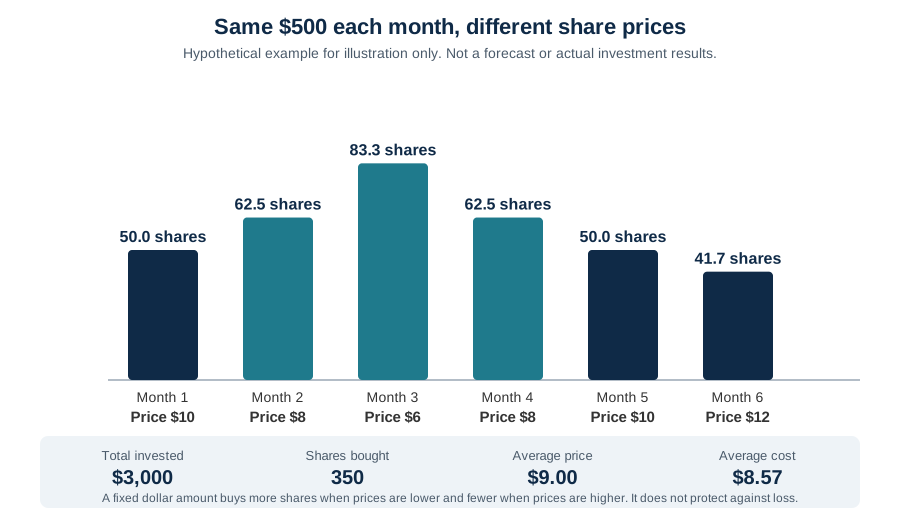
Because the same dollar amount buys more shares when the price is lower and fewer when it is higher, the average cost per share ($3,000 divided by 350 shares, or about $8.57) ends up below the simple average of the six prices ($9.00). That gap is the idea behind the name. Notice what the example does not show: it says nothing about whether the investment is a good one, and prices in real markets can fall and stay low.
Does dollar-cost averaging beat investing all at once?
This is a different question, and it applies when you already have a large sum to invest, not when you are investing from each paycheck. A Vanguard study of the U.S., U.K. and Australian markets found that investing a lump sum immediately produced higher portfolio values than spreading it over 12 months in roughly two-thirds of the rolling 10-year periods it examined. For a 60% stock and 40% bond portfolio in the U.S. (1926 to 2011), lump-sum investing came out ahead 67% of the time (Vanguard, 2012). The authors also found the lump-sum approach had losing 12-month stretches more often (22.4% of periods versus 17.6% for DCA), so DCA did reduce how often short-term losses occurred. These are historical results from one study, they exclude costs, and the future may differ.
So why do people use it anyway?
The case for DCA is often behavioral. If the thought of investing a large sum just before a decline would keep you from investing at all, a schedule can help you act. That is consistent with what we cover in loss aversion. The trade-off is that holding cash while you wait is itself a form of market timing, a point the Vanguard authors make as well. Our post on waiting for a pullback explores that further.
When does it fit, and when does it not?
- Regular contributions from income are DCA by default. You are investing as the money arrives.
- A large windfall raises the real trade-off between possible higher expected value and the comfort of a gradual entry. The right approach depends on your time horizon, risk tolerance and overall plan.
- Retirees withdrawing money face a different problem. Regular withdrawals during a decline can have the opposite effect of DCA, which is why withdrawal planning matters.
The bottom line
Dollar-cost averaging is a method for how you invest over time, not a way to avoid risk or ensure a better outcome. It can make investing a habit and may ease the anxiety of investing a large amount, but it does not guarantee a profit or protect against loss. Which approach fits you depends on your situation, and it is worth discussing with your advisor.
Ready for clarity on your retirement?
If you'd like to discuss your situation, we're happy to have an initial conversation. No pitch, no obligation — just a straightforward discussion of your circumstances and whether our approach fits your needs.
Start the ConversationKeep Reading
Choosing an Advisor
Before the Numbers: How We Start the Conversation About Money and Retirement
October 17, 2026
Behavioral Finance
The Power of Compounding: What Warren Buffett's Investing Philosophy Teaches About Growing Wealth
September 28, 2026
Tax Planning
Roth Conversions: When They Make Sense — and When They Don't
March 18, 2026
Get Our Monthly Notes
One email a month: what changed in taxes and retirement rules, and what it actually means for investors and families planning for retirement. Educational only — no pitches, no spam.
Educational content only; not investment advice. We never share your email. Unsubscribe anytime by replying.
This article is for informational and educational purposes only and does not constitute investment, tax, or legal advice, an offer of advisory services, or a solicitation. It does not account for your individual circumstances. VCP Financial is a registered investment advisor. Past performance does not guarantee future results. Consult a qualified professional before making financial decisions. For complete information about our services, fees, and potential conflicts of interest, please review our Form ADV Part 2A, available at adviserinfo.sec.gov.